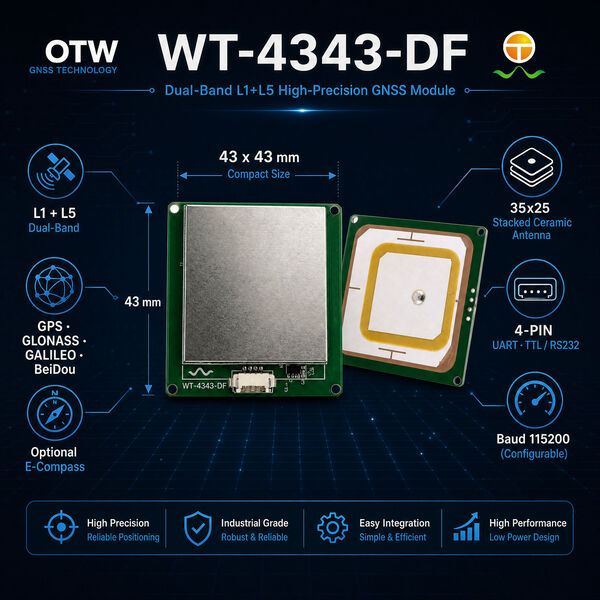
Autonomous navigation requires relentless accuracy across complex landscapes. Standard consumer chips fail under severe physical environmental stress. Signal multipath interference disrupts real-time positioning updates constantly. Fortunately, an industrial positioning module resolves these difficult operational bottlenecks smoothly. It delivers stable navigation for self-driving vehicles and unmanned drones.
This industrial hardware ensures lead-free compliance (RoHS standards) for green manufacturing. Furthermore, dual-frequency signals protect data integrity in noisy radio environments. Consequently, engineering teams deploy autonomous platforms with complete confidence now. Explore our full product-category line to upgrade your fleet hardware today.

4 Navigation Pain Points in Autonomous Systems
Unmanned aerial drones and autonomous vehicles encounter harsh physical environments daily. Basic location engines struggle during high-speed transit maneuvers. Engineers frequently face four major operational positioning challenges.
High-Speed Phase Instability on Drones
Commercial delivery drones move at high velocities through windy air. Standard single-frequency modules suffer severe phase jitter during fast turns. Consequently, flight controllers lose millimeter stability during automated landing sequences. Unmanned systems require high-refresh tracking modules to maintain balance.
Multi-Path Distortion in High-Rise Cities
Skyscrapers reflect satellite signals before reaching vehicle antennas directly. These bounced signals create massive location drift errors across downtown corridors. As a result, autonomous cars miscalculate lane positions on busy streets. Dual-frequency filtering becomes necessary to eliminate multipath interference completely.
Harsh Outdoor Temperature Spikes on Fishing Boats
Marine tracking gear endures extreme temperature swings out at sea. Solar radiation cooks unshielded electronic housings above 70°C daily. Standard receivers experience frequency drift under intense heat exposure. Marine systems need industrial components rated for extreme thermal ranges.
Excessive Energy Draw on Battery Wearables
Compact field tracking units require long battery runtimes during operations. High-power location chips drain portable power cells within hours. Therefore, field technicians lose critical location tracking during long missions. Low-power hardware architecture remains an urgent design requirement.
Technical Solutions: L1 + L5 Dual Frequency and High Refresh Rates
The OTW WT-4343-DF platform resolves signal degradation through advanced design. It delivers reliable decimeter-level accuracy across demanding commercial environments.
L1 + L5 Dual-Frequency Signal Architecture
Our advanced engine processes L1 and L5 band signals simultaneously. It tracks GPS/QZSS, BDS, GALILEO, and GLONASS constellations concurrently. Across 128 tracking channels, dual-frequency technology cancels ionospheric delays automatically. Satellite visibility increases significantly even under dense foliage canopy. Check out our detailed technical-guide on dual-band signal processing methods.
High Sensitivity and Rapid Signal Reacquisition
Integrated low-noise amplifiers deliver an exceptional -167dBm tracking sensitivity rating. The module captures weak signals down to -160dBm under canopy. Furthermore, average hot starts complete in just 1 second. Cold starts require only 28 seconds under normal sky conditions.
Industrial Thermal Endurance and Power Efficiency
Operating power consumes just 103mW at 1.8V during active tracking. Standby mode draws under 20μW to preserve main batteries. Furthermore, industrial housing withstands extreme temperatures from -40°C to 85°C. High update rates up to 10 Hz support rapid motion up to 515 m/s.

Product Specifications & Parameter Comparison
The table below highlights performance metrics for the WT-4343-DF module.
| Parameter / Feature | OTW WT-4343-DF Industrial Module | Standard Consumer GNSS Receiver |
| Supported Frequencies | L1 + L5 Dual-Frequency Multi-System | Single-Band L1 Only |
| Positioning Accuracy | Decimeter-Level (<2m + 1ppm CEP50) | Basic Meter-Level (5m – 10m) |
| Operating Temperature | Industrial Grade: -40°C to +85°C | Commercial Grade: -20°C to +60°C |
| Tracking Sensitivity | Tracking: -167dBm / Cold: -148dBm | Tracking: -155dBm / Cold: -135dBm |
| Update Rate & Speed | Up to 10 Hz / Max Speed: 515 m/s | Standard 1 Hz / Max Speed: 100 m/s |
| Power Consumption | Running: 103mW@1.8V / Standby: <20μW | Running: >250mW / Standby: >100μW |
| Compliance Standard | Lead-free Compliance (RoHS Certified) | Basic Standard CE Rating |
Diverse Deployment Scenarios for Next-Gen Mobility
This versatile dual-frequency module empowers multiple modern industrial sectors effectively.
-
Autonomous Vehicles: Self-driving cars execute precise highway maneuvers with reliable decimeter accuracy continuously.
-
Commercial Drones: Unmanned aerial vehicles execute automated flight paths safely up to 515 m/s speeds.
-
Marine Fishing Boats: Marine vessels maintain precise location tracking under harsh saltwater thermal conditions.
-
Industrial IoT Systems: Smart logistics equipment tracks asset movement effortlessly across large factory yards.
Equip your autonomous platforms with high-precision dual-frequency location engines today! Browse our comprehensive product-category catalog to order evaluation samples now.