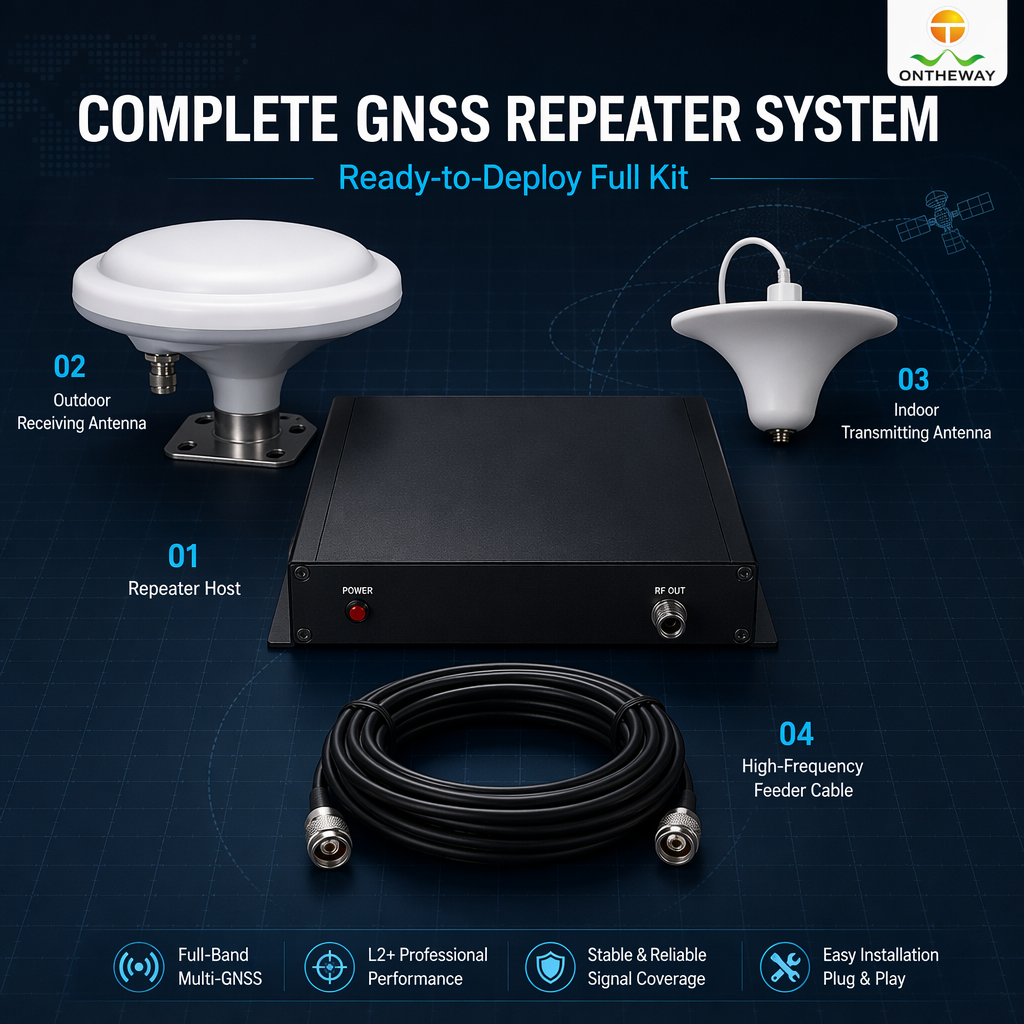
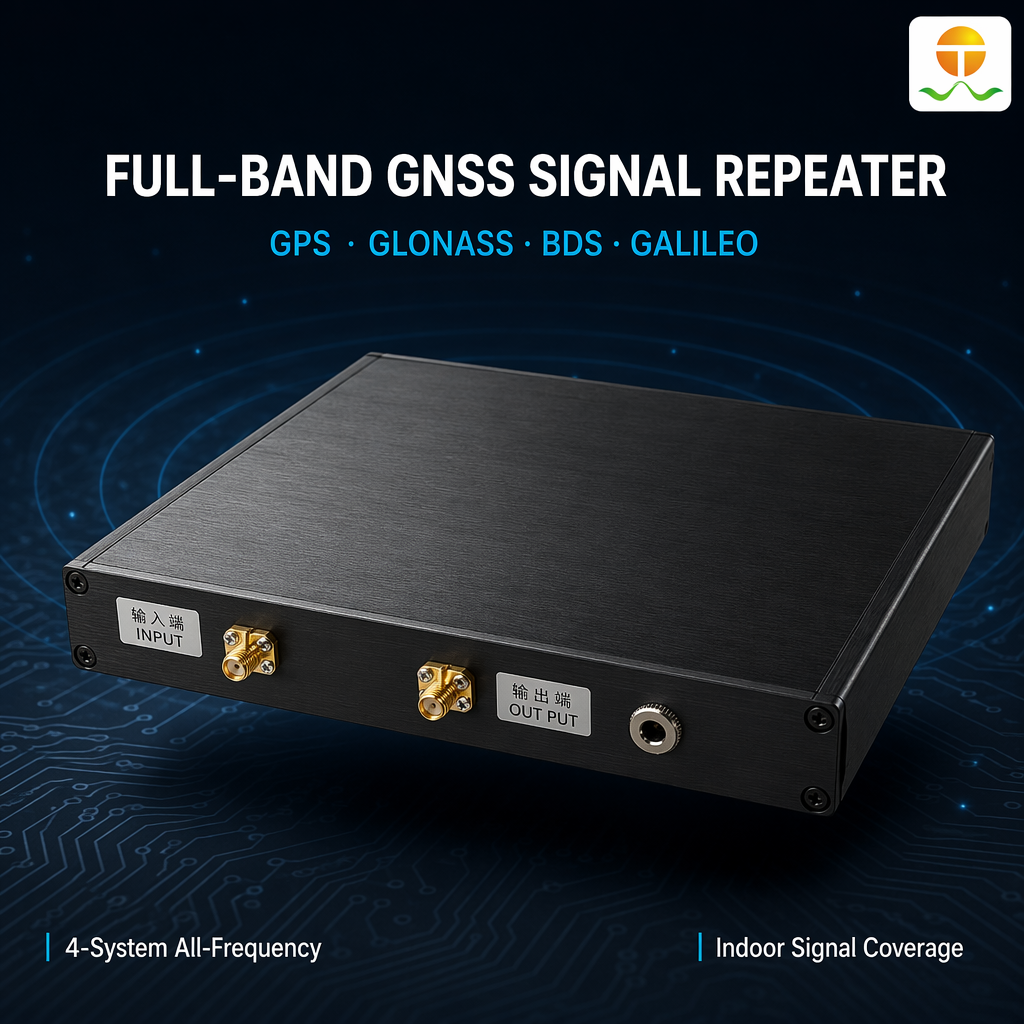
A outdoor GPS antenna system brings live satellite signals indoors for comprehensive device testing. The ONTHEWAY WT-100-FF full-band GNSS repeater streams live orbital data into shielded laboratories efficiently. Consequently, research engineers calibrate sensitive navigation equipment inside while maintaining lead-free compliance (RoHS standard) for environmental safety. Explore our complete range of frequency distribution hardware inside our product-category catalog.
Testing satellite navigation hardware outdoors poses massive logistical challenges for engineering development teams. Moving delicate electronic prototypes outside exposes sensitive circuits to harsh weather conditions and physical damage risks. Therefore, lab managers require reliable indoor signal forwarding hardware that replicates real-world sky conditions seamlessly.
Daily Testing Obstacles in Enclosed R&D Laboratories
Inability to Lock Satellite Fixes Inside Shielded Hangars
Picture an aviation team trying to calibrate flight avionics inside a massive steel aircraft hangar. Thick concrete walls and metal beams block satellite signals completely, preventing basic cold-start signal locks. Bringing a multi-ton aircraft outside for every quick diagnostic check wastes hours of technician labor. Deploying an indoor satellite signal repeater relays active satellite feeds directly onto the hangar floor. As a result, avionics technicians verify navigation fixes without tow tractors.
Unpredictable Outdoor Weather Delaying Device Calibration
Engineers testing automotive GPS receivers lose entire work days when sudden rainstorms hit outdoor test tracks. Wet weather conditions alter radio frequency propagation and ruin delicate electronic measurement setups on test benches. Utilizing a system for live GPS signal testing creates a controlled indoor testing environment permanently. Consequently, engineering teams run precise satellite calibration routines regardless of rain, snow, or excessive heat.
Bottlenecks from Individual Cable Connections on Test Benches
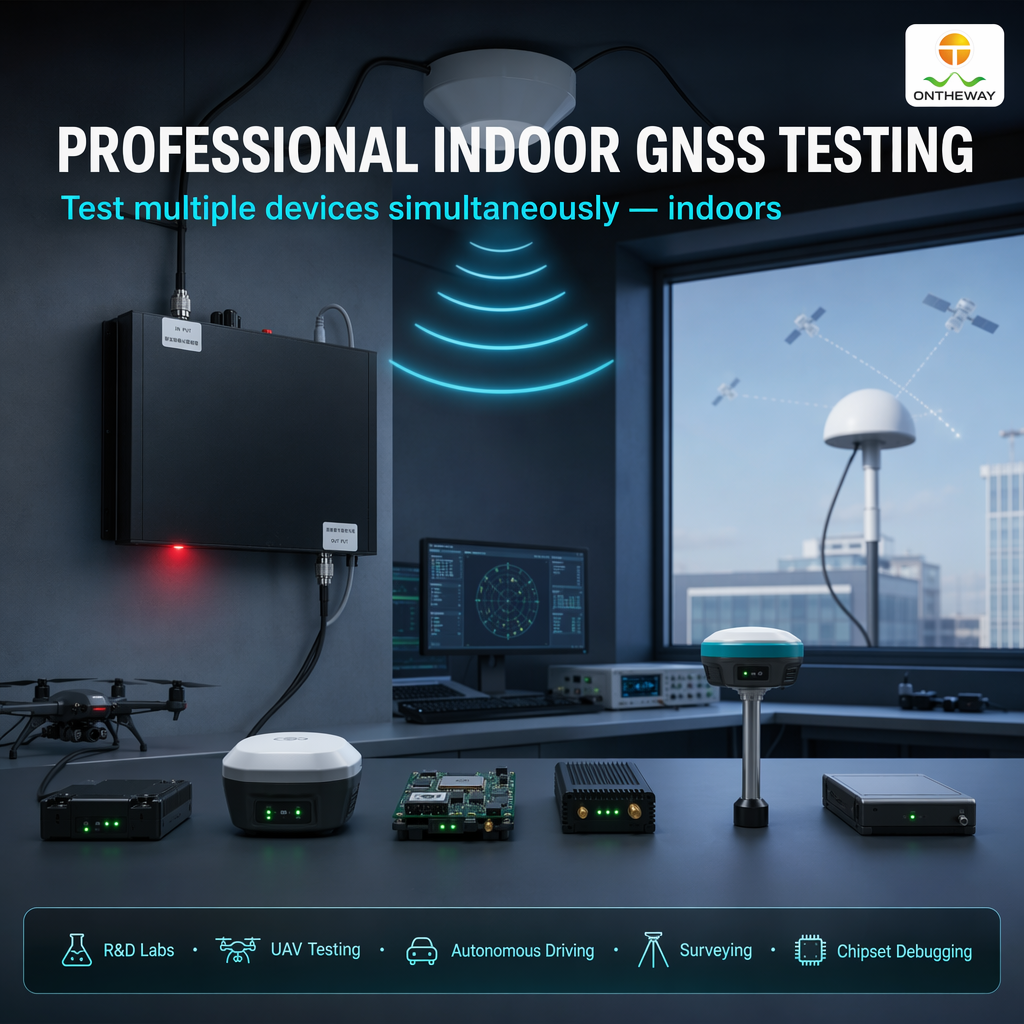
Traditional testing methods require plugging dedicated RF cables into every individual receiver unit manually. This wired approach limits the number of devices under test simultaneously, slowing down factory assembly lines. Integrating a full-band GNSS signal booster broadcasts live satellite coverage across entire laboratory rooms wirelessly. Thus, dozens of test devices lock onto satellite fixes at the same time without messy cabling.
Four-Step Signal Processing Architecture: The WT-100-FF Solution
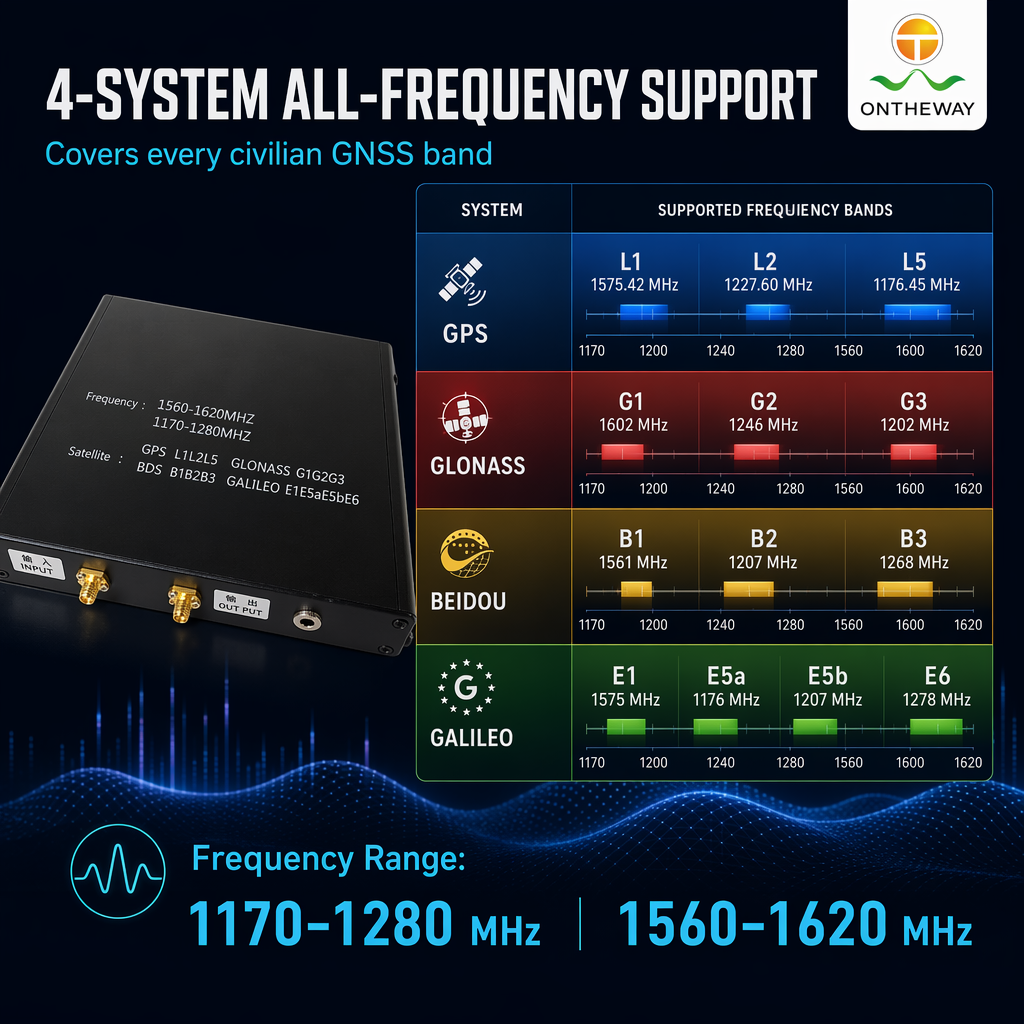
The ONTHEWAY WT-100-FF full-band repeater bridges outdoor satellite constellations directly into windowless indoor workshops. The system operates continuously across two key frequency bands: 1170–1280 MHz and 1560–1620 MHz.
Full-Band Multi-Constellation Satellite Reception
The outdoor rooftop antenna captures real-time signals from all major global navigation satellite systems simultaneously. It receives data from GPS, GLONASS, BeiDou, and Galileo constellations without missing specific orbital frequencies.
Furthermore, the high-gain antenna filters out adjacent cellular interference, ensuring clean signal delivery to the indoor host. The captured RF energy travels down low-loss coaxial cabling directly into the WT-100-FF processing unit. This comprehensive constellation coverage allows engineers to test international receivers designed for global navigation markets.
High-Gain Low-Noise Indoor Rebroadcasting
Powered by a standard AC 220V source, the WT-100-FF host unit applies precise, low-noise amplification. The internal amplifier boosts weak incoming satellite signals without introducing signal distortion or phase noise artifacts.
Moreover, the connected indoor broadcasting antenna projects the amplified satellite signal across the entire workshop floor. Unlimited receivers lock onto the broadcasted signal simultaneously without experiencing signal degradation or channel bandwidth bottlenecks. Review complete system installation guidelines inside our technical-guide documentation.
| Technical Parameter / Feature | ONTHEWAY WT-100-FF Repeater | Traditional Direct Cable Setup |
| Supported Frequencies | Dual-Band (1170–1280 & 1560–1620 MHz) | Single Channel Cable Connection |
| Constellation Support | GPS, GLONASS, BeiDou, & Galileo | Limited Single-System Testing |
| Testing Device Capacity | Unlimited Wireless Receivers | 1 Receiver per Cable Connection |
| Coverage Area Capability | Full Laboratory / Hangar Coverage | Restricted to Individual Bench |
| Primary Power Supply | AC 220 V Continuous Power | Passive or USB Power Source |
| Environmental Protection | Indoor Testing Safe from Weather | Exposed Outdoor Cables & Gear |
| System Signal Processing | High-Gain Low-Noise Amplification | Lossy Direct Cable Attenuation |
| Operational Setup Effort | Single-Time Permanent Installation | Constant Re-cabling per Device |
Optimizing Laboratory Workflow for Multi-Device Calibration
Deploying an indoor satellite signal repeater streamlines production quality control across electronic manufacturing facilities. Technicians monitor real-time satellite tracking status on multiple benchtop displays simultaneously.
In addition, wireless indoor coverage eliminates the physical clutter of tangled coaxial cables across workstations. Engineers freely move test equipment around the laboratory without losing continuous satellite locks or resetting test sequences. Thus, manufacturing facilities boost daily device throughput while reducing calibration errors significantly.
Installing a high-performance GPS antenna repeater system optimizes R&D testing efficiency while protecting sensitive electronic equipment. Full-band multi-constellation support ensures complete receiver testing under true indoor conditions. Upgrade your testing facility today to achieve seamless, indoor satellite connectivity.