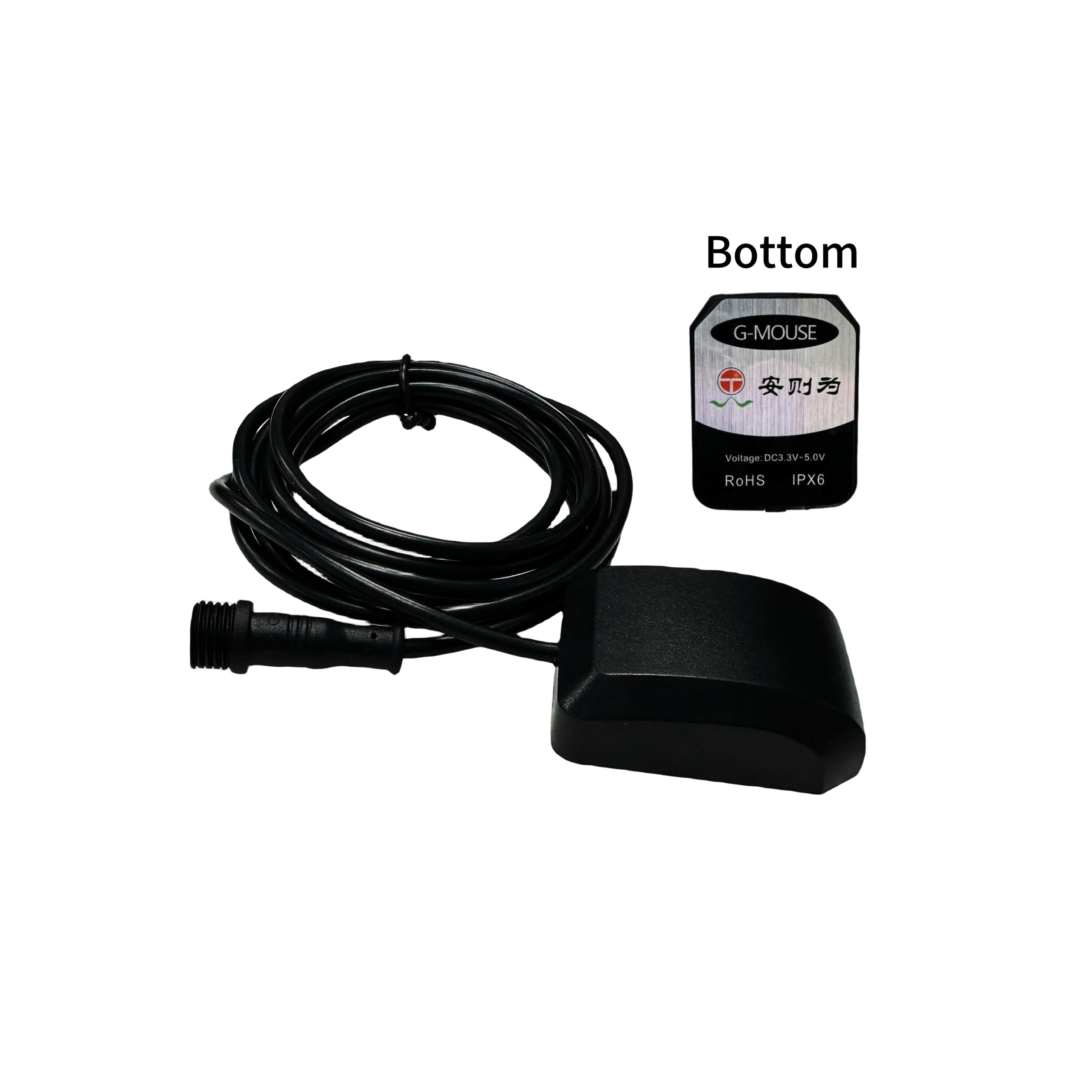
Integrating an advanced Récepteur GPS G-Mouse delivers sub-meter positioning accuracy, eliminates signal loss during sharp flight maneuvers, and simplifies drone hardware integration. Featuring integrated active ceramic patch antennas, high-gain low-noise amplifiers, and simultaneous multi-constellation tracking, this external GNSS receiver provides rock-solid position hold and automated return-to-home capabilities. Sourcing this robust, cost-effective receiver unit delivers exceptional value, empowering drone manufacturers, agricultural surveyors, and commercial UAV operators to upgrade flight stability affordably today.
This high-performance positioning hardware satisfies strict lead-free compliance standards (Certifications RoHS et CE) while operating across harsh environmental temperature extremes from minus forty to plus one hundred five degrees Celsius. Entre-temps, its built-in Surface Acoustic Wave filter suppresses high-frequency motor noise and video transmission interference. Par conséquent, flight control systems maintain continuous satellite locks during complex automated navigation missions. Découvrez notre complète catégorie de produit catalog to order integrated G-Mouse navigation modules online now.

4 UAV Navigation Challenges Impairing Unmanned Autonomous Flights
UAV flight controllers, mapping engineers, and law enforcement drone operators regularly face positional drift, signal jamming, and high power drain. Compact multirotor frames generate severe electromagnetic noise, which disrupts unshielded positioning chips and causes sudden trajectory deviations. Flight hardware integration specialists frequently observe four critical technical obstacles across conventional drone navigation setups.
Severe Motor Electromagnetic Noise Inducing Flight Drift
High-current electronic speed controllers and brushless motors generate intense electromagnetic interference across drone frames. Unshielded board-level receivers lose satellite lock under heavy acceleration, causing dangerous flight drift during autonomous missions. Operators must manually regain control or risk losing expensive survey equipment in hard-to-reach areas. Integrated G-Mouse receivers enclose active antennas and filtering electronics inside metallic shielding, isolating positioning circuits from motor noise.
Excessive Cold Start Delays Draining Battery Capacity
Standard standalone GPS chips require several minutes to acquire satellite ephemeris data when powered on in unfamiliar locations. Waiting for a valid position fix on the launchpad consumes valuable battery energy before takeoff. Par conséquent, commercial operators lose productive flight time during time-sensitive inspection tasks or search missions. Multi-constellation tracking engines lock onto three satellite networks simultaneously, delivering fast hot-start positioning within seconds.
Urban Multi-Path Signal Reflections Threatening Automated Return
Reflective glass buildings and concrete structures bounce satellite signals, creating multi-path phase errors that mislead drone flight algorithms. Distorted positioning data triggers erratic position-hold adjustments or causes automated return-to-home routines to miscalculate landing sites. Ainsi, surveying crews struggle to maintain precision mapping grids inside urban canyons or industrial parks. High-gain active ceramic patch antennas filter reflected signals, ensuring accurate coordinate calculations in challenging environments.
Complex Separate Component Wiring Adding Frame Weight
Wiring standalone GPS boards, external active patch antennas, and separate low-noise amplifiers requires multiple interconnect cables and mounting brackets. Additional wiring points increase physical weight, reduce flight times, and introduce mechanical solder failure risks from continuous motor vibration. Par conséquent, UAV assembly technicians face higher labor costs and frequent wiring maintenance issues. All-in-one G-Mouse modules combine the antenna and receiver board inside a single weatherproof housing.

Solutions techniques: WT-2828-UB-R232-AV Positioning Module
The WT-2828-UB-R232-AV G-Mouse receiver combines integrated active antennas, triple-constellation tracking, and automotive-grade durability.
Integrated Active Antenna Architecture with Superior Sensitivity
Engineered with an internal high-gain low-noise amplifier and a Surface Acoustic Wave filter, this unit delivers ultra-high sensitivity. The integrated design maintains optimal radio frequency performance even when processing weak signals in dense urban areas. En outre, check out our detailed guide-technique regarding RS-232 pinouts, baud rate selection, and flight controller serial port setup.
Simultaneous Triple-GNSS Reception and Augmentation Support
Supporting synchronous reception across GPS, Beidou, Glonass, and Galileo constellations, this receiver maximizes visible satellite counts worldwide. Compatibility with Satellite-Based Augmentation Systems enhances real-time coordinate accuracy and flight stability. Par conséquent, autonomous drones perform precision agricultural spraying, cartographie, and law enforcement surveillance with complete confidence.
Automotive-Grade Durability with Low Power Consumption
Built around automotive-grade processing silicon, the module operates reliably across extreme temperatures from minus forty to plus one hundred five degrees Celsius. Low power consumption preserves battery life, extending flight endurance during long-range mapping missions. En plus, direct manufacturer pricing delivers high-performance G-Mouse positioning hardware at an exceptionally accessible, budget-friendly acquisition cost.
Technical Specifications & Receiver Comparison
The table below compares the WT-2828-UB-R232-AV G-Mouse receiver against standard unshielded GPS modules and basic USB dongles.
| Specification Parameter | WT-2828-UB-R232-AV | Unshielded GPS Module | Basic USB GPS Dongle |
| Prise en charge des constellations | GPS, Bds, Glonass, FILLE | GPS Only | GPS, Glonass |
| Intégration d'antenne | Built-in Active Ceramic | External Passive Patch | Internal Micro Patch |
| RF Noise Filtering | High-Gain LNA + SCIE | None or LNA Only | Basic LNA Filter |
| Température de fonctionnement | -40°C to +105°C Range | -20°C to +70°C Range | -10°C to +60°C Range |
| Sensibilité du signal | Ultra-High Tracking | Standard Tracking | Moderate Tracking |
| Data Protocol Support | RS-232 / NMEA Output | TTL Serial / NMEA | USB Virtual COM Port |
| Ingress Protection | Weatherproof Enclosure | Exposed PCB Board | Light Plastic Casing |
| Value Rating | Exceptionnel (High Tech) | Faible (Needs Filters) | Faible (Vibration Weak) |
Versatile Deployments Across Autonomous Navigation Systems
Consider these primary commercial deployment scenarios when specifying G-Mouse positioning receivers for your flight systems today.
-
Commercial Drone Navigation: Mounting integrated G-Mouse receivers on drone top-decks provides steady positioning for automated waypoint mapping.
-
Agricultural Surveying UAVs: High-sensitivity triple-GNSS tracking ensures accurate flight lines during crop-monitoring runs over large farms.
-
Law Enforcement & Patrol Gear: Ruggedized G-Mouse modules deliver reliable geographic coordinate tagging for tactical gear and mobile command posts.
-
Portable Surveying Tools: Low-power serial receivers feed continuous GNSS data into handheld computers for field boundary mapping.
Maximize your drone flight precision and secure the ultimate navigation hardware investment value today! Parcourez notre vaste catégorie de produit selection to order high-sensitivity G-Mouse GPS receivers now.